Metal & Colorbond Roofing Blue Mountains
Colorbond steel is increasingly the roof of choice for Blue Mountains homeowners and builders — lighter than tile, low maintenance, and well-suited to the mountain climate. We install, replace and maintain metal and Colorbond roofs across the region, including the tile-to-metal conversions that have become one of our most requested services.
- 🛡️ 7 Year Warranty*
- ✅ Licensed & Insured
- 📍 Local Blue Mountains Team
What's Included
- Colorbond steel installation
- Metal roof replacement
- Tile-to-metal conversion
- Metal roof maintenance
- Metal roof repairs
- New Colorbond gutters & downpipes
Not sure if metal & colorbond roofing is what your roof needs?
We inspect first and tell you straight — repair, restore or replace.
Why Colorbond works well in the Blue Mountains
The Blue Mountains' combination of high rainfall, frost, heavy leaf-fall and occasional snow creates conditions where metal roofing's advantages over tile are particularly clear. A Colorbond roof has no mortar to crack in winter, no tile clips to corrode, no tile profile to collect debris in the valleys, and a smooth surface that sheds moisture, frost and leaf litter quickly. Modern Colorbond steel is engineered for Australian conditions — the Activate® technology in the current product range improves corrosion resistance, and the baked-on paint system outperforms painted roofing in both adhesion and UV resistance. For bushland-edge properties with a Bushfire Attack Level rating, the smooth non-combustible surface performs well. Colorbond is available in a wide range of profiles and over 22 standard colours, with some mountain-appropriate options that sit sympathetically in natural settings.
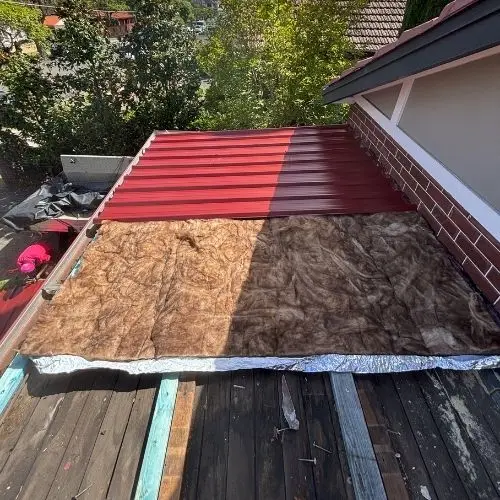
Metal roof maintenance — what actually matters
Metal roofs require less maintenance than tile, but they're not maintenance-free. Fasteners — particularly hex-head screws used in older metal roofing — can back out over time as the metal expands and contracts, allowing water entry. Lap sealants at sheet overlaps dry out and pull away from the metal surface, particularly in high UV environments. Rusting commonly starts at cut edges (where the cut exposes the steel core), at fastener points and at areas where standing water occurs. A metal roof maintenance check every five to ten years — inspecting fasteners, laps, flashings and the surface condition — catches these problems while they're minor. Left unaddressed, lap failures and fastener-point rust can lead to widespread sheeting damage that's significantly more expensive to fix.
Colorbond profile options — what suits a Blue Mountains home
Colorbond is available in a range of profiles, and the choice affects both the visual character of the finished roof and practical installation details. Classic corrugated profile — the traditional round-ribbed steel sheeting — is appropriate for traditional-character homes and rural-edge properties across the Mountains, and is often the profile most readily accepted in heritage guidelines where metal roofing is permitted. Low-profile ribbed sheeting has become the standard for most residential re-roofing and new installations — it has a cleaner, more contemporary appearance than corrugated and suits the range of housing built across the Blue Mountains from the 1960s onwards. Concealed-fastener profiles, where screws are hidden under the sheeting, provide a very flat, premium appearance suited to contemporary custom homes and some commercial applications. We discuss profile options — including any heritage or Council restrictions that apply to your specific property — during the quote process.
| Profile type | Visual character | Common application | Heritage compatibility |
|---|---|---|---|
| Classic corrugated | Traditional round-ribbed profile with visual depth | Traditional residential, heritage-adjacent homes, rural-edge and shed applications | Generally accepted where metal is permitted in conservation areas — confirm with Council |
| Low-profile rib (Trimdek-type) | Lower, flatter ribs — cleaner and more contemporary than corrugated | Most residential re-roofing and new installations across the Mountains | Typical for modern residential applications — confirm with Council for heritage properties |
| Concealed-fastener / standing seam | Very flat, with only the seam visible as a design detail | Contemporary custom homes, commercial buildings and premium residential applications | Specialist architectural use — heritage check required before specifying |
How the work is done
Our metal roofing process
- 01
On-roof assessment
We inspect the existing roof or substrate — tile condition, batten spacing, rafter tops and site access — and identify the full scope of work before preparing the written quote.
- 02
Product and colour selection
We discuss Colorbond profile options, colour choices and any heritage or Council requirements relevant to your property. A fixed written quote covering all specified materials and labour is provided.
- 03
Old roof removal
Existing tiles, old metal sheeting or other roofing is stripped, loaded and removed from site. Valley iron, flashings and fascia gutters are removed at the same time.
- 04
Batten inspection and preparation
All battens are inspected for rot, twist and correct spacing for the Colorbond profile selected. Undersized or failed battens are replaced before sarking is laid.
- 05
Sarking installation
Anti-condensation sarking is laid over the full roof from eave to ridge, correctly lapped and fixed to battens before any sheeting is installed.
- 06
Colorbond sheet installation
Sheets are fixed at the correct fastener centres for the profile, the pitch and the wind region. Lap and seam details are formed correctly to prevent water ingress.
- 07
Ridge, hip, valley and flashing installation
All ridge caps, hip cappings, valley flashings, barge cappings and wall flashings are installed to correct profiles and details. All penetrations are sealed.
- 08
Gutters, downpipes and handover
Matched Colorbond gutters and downpipes are installed, graded and connected to stormwater outlets. The completed roof is inspected, debris cleared and the written 7-year warranty provided.
What the job covers
Everything included in your metal & colorbond roofing
One fixed written quote
Every item is priced in the quote you receive after inspection — no line-item surprises once work starts.
- 01
Colorbond steel installation
All standard Colorbond profiles including corrugated, trimdek and custom standing seam.
- 02
Metal roof replacement
Old metal or tile roof removed and replaced with new Colorbond system.
- 03
Tile-to-metal conversion
Full tile strip, batten re-grading, sarking and new Colorbond install.
- 04
Metal roof maintenance
Fastener inspection, lap sealant renewal, rust treatment and surface coating.
- 05
Metal roof repairs
Rust patches, failed laps, storm damage and fastener-point leaks repaired.
- 06
New Colorbond gutters & downpipes
Matched gutters and downpipes installed or replaced with the roof.
Let's take a look at your roof
Free inspection, photos of what we find, and a fixed written quote for the work your roof actually needs.
Straight about price
What does it cost?
Metal roof costs depend on profile, colour, roof area and complexity, and whether the job includes a tile strip, sarking and gutters. Fixed written quote after free inspection. Call (02) 4742 0922.
Questions before you enquire
Metal & Colorbond Roofing questions
Straight answers to what Blue Mountains homeowners ask us most about metal & colorbond roofing.
How long does a Colorbond roof last?
A well-specified, correctly installed metal roof can perform well for decades. How long depends on the specific product chosen, the local environment (salt, UV, rainfall) and how well the installation details — fasteners, laps and flashings — are executed. We'll talk you through the right product for your home's exposure and conditions during your free inspection, including whatever manufacturer warranty applies to that product.
Is Colorbond noisy in heavy rain?
An uninsulated metal roof is noticeably louder in heavy rain than a tile roof. The solution is anti-condensation sarking (which also provides a degree of acoustic dampening) and, for premium performance, insulated roofing blanket or bulk insulation in the ceiling space. We discuss insulation as part of every new Colorbond installation — the Blue Mountains climate makes good ceiling insulation worthwhile in both summer and winter.
What Colorbond colour should I choose?
Standard Colorbond colours range from deep charcoal and dark grey tones through to warm beiges and earthy greens. For Blue Mountains settings, darker tones like Monument, Basalt and Ironstone are popular and sit well in bushland contexts. Lighter colours reflect more heat (relevant in summer) but may show dirt and lichen growth more quickly in the high-rainfall environment. For heritage-adjacent properties, check with BMCC for any colour guidance.
Can you restore a rusted Colorbond roof rather than replacing it?
Yes — if the rust is surface or spot corrosion and hasn't penetrated through the steel, we can treat, prime and re-coat the affected areas. If rust has caused perforation (holes through the sheet), the affected sheeting needs to be replaced. Our inspection will tell you which situation you're in.
Can my existing metal roof be repaired rather than replaced?
In many cases, yes. Surface rust can be treated and sealed before it penetrates through. Lap sealants that have dried out and pulled away can be re-applied. Fasteners that have backed out can be replaced or capped. The question is whether targeted repairs represent good value relative to the roof's overall condition and remaining life expectancy. Our inspection gives you a straight assessment of whether repair or replacement is the better investment for your specific situation.
How does a tile-to-Colorbond conversion differ from a standard metal re-roof?
A tile-to-metal conversion involves stripping existing tiles, inspecting the batten framework — battens on a tile roof are typically spaced for tile gauge, which differs from the spacing Colorbond profiles require — and in some cases conducting a structural assessment of the rafters and wall plates to confirm they can handle the process safely. Weight reduction from removing concrete tile is significant; some older roof structures need specific attention during the changeover. Once the framework is confirmed and prepared, the installation process is the same as any Colorbond installation: sarking, sheets, ridge, flashings and gutters. We include the batten inspection as part of the pre-quote process.
Metal & Colorbond Roofing across the Blue Mountains
Servicing all Blue Mountains towns and suburbs including:
Request an inspection
Ready for honest advice on your roof?
Free inspection, written fixed quote, and a straight answer — repair, restore or replace. Call (02) 4742 0922 or use the form.
GET YOUR FREE
ROOF INSPECTION & QUOTE
No obligation. Fast and reliable. 100% free.
- ✅ Fast Response
- ✅ Local Experts
- ✅ No Obligation
Prefer to talk? Call (02) 4742 0922